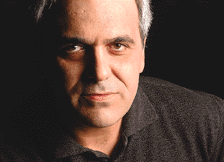
του Νίκου Δήμου
Lifo
7 Μαρτίου 2012
Καλά να είναι δύσκολες οι επιλογές στη ζωή - αλλά να είναι ακόμα δυσκολότερες οι μεταθανάτιες;
Σε αυτήν τη χώρα, όπου οι ελευθερίες όλο και στενεύουν, όπου δανειστές, πολιτικοί, συνδικαλιστές, μας πιέζουν από κάθε πλευρά, έρχονται τώρα αρχιερείς και Φαρισαίοι να μας επιβάλουν τη μεταθανάτια μοίρα μας.
Την ιστορία ίσως την έχετε ακούσει. Ομόφωνα το Δημοτικό Συμβούλιο Μαρκόπουλου είχε αποφασίσει τη δημιουργία αποτεφρωτηρίου νεκρών. Ομόφωνα.
(Υπενθυμίζω πως ο σχετικός νόμος έχει ψηφιστεί εδώ κι έξι χρόνια. Και όλα τα σχετικά διατάγματα, υπουργικές αποφάσεις κι ερμηνευτικές εγκύκλιοι είναι έτοιμες από καιρό).
Αλλά ο Μητροπολίτης Μεσογαίας Νικόλαος, ο θεωρούμενος και εκσυγχρονιστής, αλλιώς αποφάσισε. Από τον άμβωνα ξεσήκωσε τους χριστιανούς να πολεμήσουν: «Με πρόφαση τα όποια οικονομικά οφέλη, εντελώς αβίαστα κάποιοι επιδιώκουν να εισαγάγουν πρωτόγνωρα ήθη, ποδοπατώντας διαχρονικές, ιερές παραδόσεις και περιφρονώντας την εκκλησιαστική μας συνείδηση».
Περισσότερα
This blog is dedicated to the worldwide struggle for freedom, individual liberties, personal autonomy and the right to self-ownership - against any kind of legal paternalism, legal moralism and authoritarianism. Its aim is to post related news and commentary published mainly in the major U.S., European and Greek media. It was created by Prof. Aristides Hatzis of the University of Athens.
Wednesday, March 7, 2012
Friday, February 24, 2012
Η "επικίνδυνη" ελευθερία
του Αριστείδη Χατζή
Τα Νέα
23 Φεβρουαρίου 2012
Η είδηση πέρασε σχεδόν απαρατήρητη. Στις αρχές Σεπτεμβρίου το Μονομελές Πρωτοδικείο Λαμίας έκρινε παράνομη και απέρριψε την αίτηση για ίδρυση συλλόγου που είχαν υποβάλει σπουδαστές στο ΤΕΙ Λαμίας. Αυτό που ενόχλησε το δικαστήριο ήταν ότι στους βασικούς σκοπούς του συλλόγου συμπεριλαμβάνονταν η δράση ενάντια «στους ιμπεριαλιστικούς σχεδιασμούς ΗΠΑ - ΝΑΤΟ - ΕΕ». Σύμφωνα με την απόφαση, ο σύλλογος ενδέχεται να επιδιώκει σκοπούς οι οποίοι δεν εναρμονίζονται με τη νομιμότητα, αντίκεινται σε κανόνες δημόσιας τάξης, δηλαδή σε «διατάξεις αναγκαστικού δικαίου που συγκροτούν τα θεμέλια του κρατικού κοινωνικού και οικονομικού συστήματος της χώρας». Ανατριχιάσατε; Υπάρχει και συνέχεια: το δικαστήριο φοβάται ότι εξαιτίας της δράσης του συλλόγου μπορεί να διαταραχθούν οι φιλικές σχέσεις της Ελλάδας με τις ΗΠΑ, το ΝΑΤΟ και την ΕΕ!
Αν αναρωτιέστε για το πώς μπορεί να το πετύχει αυτό μια ομάδα φοιτητών του ΤΕΙ Λαμίας, θα βρείτε την απάντηση στην απόφαση: επειδή στο καταστατικό δεν κατονομάζονται με σαφήνεια οι δομές του συλλόγου, το δικαστήριο θεωρεί ότι δεν μπορεί να αποκλειστεί η πιθανότητα να μετέρχεται το σωματείο και παράνομα ή βίαια μέσα για την επίτευξη του σκοπού του. Αν σας ακούγεται υπερβολικό μην ανησυχείτε, το δικαστήριο διαθέτει μια σοβαρή ένδειξη: σύμφωνα με το καταστατικό του σωματείου, δεν μπορούν να εγγραφούν ως μέλη όσοι υπηρετούν ή υπηρετούσαν στα σώματα ασφαλείας.
Ποιο θα είναι το επόμενο βήμα; Η απαγόρευση του ΚΚΕ και η διάλυση του ΣΥΡΙΖΑ; Μήπως θα πρέπει να ζητηθεί η άρση της βουλευτικής ασυλίας της κας Παπαρήγα επειδή έχει δηλώσει: «Εμείς στο ΚΚΕ είμαστε αντίθετοι με το Σύνταγμα. Δεν συμφωνούμε και το έχουμε καταψηφίσει. Είναι Σύνταγμα αντιλαϊκό και για το ΚΚΕ το μόνο δίκιο είναι του εργαζόμενου». Αν είμαστε μάλιστα συνεπείς, θα πρέπει να στραφούμε έπειτα στην Ακρα Δεξιά. Θα απαγορεύσουμε τη Χρυσή Αυγή; Τις φιλοβασιλικές και φιλοχουντικές οργανώσεις; Θα βάλουμε χέρι στον ΛΑΟΣ; (όλο και κάτι ανατρεπτικό θα βρούμε).
Η απόφαση αυτή δεν έπεσε από τον ουρανό. Το δικαστήριο βασίζεται σε ένα νομικό πλαίσιο που έχει σκοπό να περιορίσει τις ελευθερίες και αποτελεί κατασκεύασμα του βαθέως πατερναλιστικού και αντιφιλελεύθερου ελληνικού κράτους. Όπως λέει και η απόφαση: «η ελευθερία της ενώσεως (και μάλιστα όχι μόνο της συστάσεως αλλά και της λειτουργίας της ενώσεως) τελεί υπό τη γενική επιφύλαξη του νόμου». Ενός νόμου που αναφέρεται σε απαρχαιωμένες έννοιες όπως «δημόσια τάξη» και «χρηστά ήθη» – έννοιες που αποπνέουν συντηρητισμό, νομικό ηθικισμό και κυρίως περιορισμό της ελευθερίας της έκφρασης.
Διαβάστε εδώ τη συνέχεια του άρθρου
Εδώ θα βρείτε το άρθρο σε μορφή PDF
Εδώ θα βρείτε ένα σχετικό άρθρο του Ριζοσπάστη με links σε άλλα σχετικά δημοσιεύματα
Μπορείτε να διαβάσετε άλλα δύο άρθρα μου για τους περιορισμούς στην ελευθερία του λόγου και της έκφρασης στην Ελλάδα:
"Κανένας Νόμος να μην Περιορίζει την Ελευθερία του Λόγου και της Έκφρασης" (Το Βήμα, 10/3/2011)
"Η Προσβολή των Θεσμών" (Το Βήμα, 5 Μαΐου 2011)
Εδώ μπορείτε να συμμετάσχετε σε ένα σχετικό Cause που έχω δημιουργήσει στο Facebook με θέμα την προστασία της ελευθερίας του λόγου και της έκφρασης στην Ελλάδα. Έχει ήδη περίπου 4.000 μέλη.
Τα Νέα
23 Φεβρουαρίου 2012
Η είδηση πέρασε σχεδόν απαρατήρητη. Στις αρχές Σεπτεμβρίου το Μονομελές Πρωτοδικείο Λαμίας έκρινε παράνομη και απέρριψε την αίτηση για ίδρυση συλλόγου που είχαν υποβάλει σπουδαστές στο ΤΕΙ Λαμίας. Αυτό που ενόχλησε το δικαστήριο ήταν ότι στους βασικούς σκοπούς του συλλόγου συμπεριλαμβάνονταν η δράση ενάντια «στους ιμπεριαλιστικούς σχεδιασμούς ΗΠΑ - ΝΑΤΟ - ΕΕ». Σύμφωνα με την απόφαση, ο σύλλογος ενδέχεται να επιδιώκει σκοπούς οι οποίοι δεν εναρμονίζονται με τη νομιμότητα, αντίκεινται σε κανόνες δημόσιας τάξης, δηλαδή σε «διατάξεις αναγκαστικού δικαίου που συγκροτούν τα θεμέλια του κρατικού κοινωνικού και οικονομικού συστήματος της χώρας». Ανατριχιάσατε; Υπάρχει και συνέχεια: το δικαστήριο φοβάται ότι εξαιτίας της δράσης του συλλόγου μπορεί να διαταραχθούν οι φιλικές σχέσεις της Ελλάδας με τις ΗΠΑ, το ΝΑΤΟ και την ΕΕ!
Αν αναρωτιέστε για το πώς μπορεί να το πετύχει αυτό μια ομάδα φοιτητών του ΤΕΙ Λαμίας, θα βρείτε την απάντηση στην απόφαση: επειδή στο καταστατικό δεν κατονομάζονται με σαφήνεια οι δομές του συλλόγου, το δικαστήριο θεωρεί ότι δεν μπορεί να αποκλειστεί η πιθανότητα να μετέρχεται το σωματείο και παράνομα ή βίαια μέσα για την επίτευξη του σκοπού του. Αν σας ακούγεται υπερβολικό μην ανησυχείτε, το δικαστήριο διαθέτει μια σοβαρή ένδειξη: σύμφωνα με το καταστατικό του σωματείου, δεν μπορούν να εγγραφούν ως μέλη όσοι υπηρετούν ή υπηρετούσαν στα σώματα ασφαλείας.
Ποιο θα είναι το επόμενο βήμα; Η απαγόρευση του ΚΚΕ και η διάλυση του ΣΥΡΙΖΑ; Μήπως θα πρέπει να ζητηθεί η άρση της βουλευτικής ασυλίας της κας Παπαρήγα επειδή έχει δηλώσει: «Εμείς στο ΚΚΕ είμαστε αντίθετοι με το Σύνταγμα. Δεν συμφωνούμε και το έχουμε καταψηφίσει. Είναι Σύνταγμα αντιλαϊκό και για το ΚΚΕ το μόνο δίκιο είναι του εργαζόμενου». Αν είμαστε μάλιστα συνεπείς, θα πρέπει να στραφούμε έπειτα στην Ακρα Δεξιά. Θα απαγορεύσουμε τη Χρυσή Αυγή; Τις φιλοβασιλικές και φιλοχουντικές οργανώσεις; Θα βάλουμε χέρι στον ΛΑΟΣ; (όλο και κάτι ανατρεπτικό θα βρούμε).
Η απόφαση αυτή δεν έπεσε από τον ουρανό. Το δικαστήριο βασίζεται σε ένα νομικό πλαίσιο που έχει σκοπό να περιορίσει τις ελευθερίες και αποτελεί κατασκεύασμα του βαθέως πατερναλιστικού και αντιφιλελεύθερου ελληνικού κράτους. Όπως λέει και η απόφαση: «η ελευθερία της ενώσεως (και μάλιστα όχι μόνο της συστάσεως αλλά και της λειτουργίας της ενώσεως) τελεί υπό τη γενική επιφύλαξη του νόμου». Ενός νόμου που αναφέρεται σε απαρχαιωμένες έννοιες όπως «δημόσια τάξη» και «χρηστά ήθη» – έννοιες που αποπνέουν συντηρητισμό, νομικό ηθικισμό και κυρίως περιορισμό της ελευθερίας της έκφρασης.
Διαβάστε εδώ τη συνέχεια του άρθρου
Εδώ θα βρείτε το άρθρο σε μορφή PDF
Εδώ θα βρείτε ένα σχετικό άρθρο του Ριζοσπάστη με links σε άλλα σχετικά δημοσιεύματα
Μπορείτε να διαβάσετε άλλα δύο άρθρα μου για τους περιορισμούς στην ελευθερία του λόγου και της έκφρασης στην Ελλάδα:
"Κανένας Νόμος να μην Περιορίζει την Ελευθερία του Λόγου και της Έκφρασης" (Το Βήμα, 10/3/2011)
"Η Προσβολή των Θεσμών" (Το Βήμα, 5 Μαΐου 2011)
Εδώ μπορείτε να συμμετάσχετε σε ένα σχετικό Cause που έχω δημιουργήσει στο Facebook με θέμα την προστασία της ελευθερίας του λόγου και της έκφρασης στην Ελλάδα. Έχει ήδη περίπου 4.000 μέλη.
Thursday, February 16, 2012
Όπισθεν ολοταχώς
του Κωστή Παπαϊωάννου
Τα Νέα
16 Φεβρουαρίου 2012
Προ ημερών βουλευτής του ΛΑΟΣ αποκάλυψε ότι με το σχέδιο νόμου για τα ναρκωτικά, «μπορεί ένας πατέρας να κάνει χρήση ηρωίνης παρουσία του 12χρονου παιδιού του...». Προφανώς μέχρι σήμερα τον ασυνείδητο πατέρα συγκρατούσε το αυστηρό νομικό πλαίσιο. Βαδίζοντας στα μονοπάτια που άνοιξε η οξυδερκής παρατήρηση του βουλευτή το ΚΚΕ χαρακτήρισε το νομοσχέδιο έγκλημα, ενώ η Αλέκα Παπαρήγα έκανε λόγο για «εξίσου σοβαρό ζήτημα με τη δανειακή σύμβαση, το PSI και τα άλλα μέτρα». Αποφεύγουμε, με δυσκολία είναι η αλήθεια, τον εύκολο πειρασμό της ταύτισης της «εθνικόφρονος Ορθοδοξίας» με την κομμουνιστική αντίστοιχη. Το ζήτημα είναι ευρύτερο και αφορά μια γενικότερη αναδίπλωση σε συντηρητικότερες θέσεις.
Η δημόσια συζήτηση για την αποποινικοποίηση της χρήσης ναρκωτικών είναι καλό παράδειγμα αυτής της αναδίπλωσης. Οπως επισήμανε και η Ελληνική Ενωση για τα Δικαιώματα του Ανθρώπου και του Πολίτη, θεωρητικά το ζήτημα της αποποινικοποίησης είναι κομβικής σημασίας: αφορά μια πράξη αυτοπροσβολής και ο κάθε άνθρωπος δεν μπορεί παρά να έχει δικαίωμα να διαθέτει ελεύθερα το σώμα του, έστω και για να του προκαλέσει βλάβες. Πρακτικά ωστόσο η βαρύτητα του θέματος έχει καταστεί δευτερεύουσα αφού κανείς πλέον δεν βρίσκεται έγκλειστος εξαιτίας μόνο της χρήσης ναρκωτικών. Τα κόμματα που τάσσονται κατά της αποποινικοποίησης (ΝΔ, ΚΚΕ, ΛΑΟΣ) δίνουν μάχη σκληρή μεν αλλά εκτός τόπου και χρόνου. Προκειμένου να καλοπιάσουν τους μικρομεσαίους ψηφοφόρους, αποστρέφουν το βλέμμα από το μείζον, τις μάζες έγκλειστων χρηστών, εξαθλιωμένων και χωρίς σοβαρή πιθανότητα επανένταξης. Αποσιωπούν τις συνθήκες που οδήγησαν τους περισσότερους εκεί: δυσανάλογες ποινές (π.χ. ισόβια) ακόμα και για κατά συνήθεια διακίνηση (όπου εμπίπτουν οι εξαρτημένοι μικροδιακινητές), ελάχιστο όριο ποινής για συνηθισμένη διακίνηση τα 10 χρόνια. Με απλά λόγια, προκειμένου να κάνουν πολιτικό ταμείο καταπίνουν τον κοινωνικό Καιάδα της άμετρης ποινικής καταστολής και διυλίζουν τον κώνωπα της αποποινικοποίησης.
Περισσότερα
Τα Νέα
16 Φεβρουαρίου 2012
Προ ημερών βουλευτής του ΛΑΟΣ αποκάλυψε ότι με το σχέδιο νόμου για τα ναρκωτικά, «μπορεί ένας πατέρας να κάνει χρήση ηρωίνης παρουσία του 12χρονου παιδιού του...». Προφανώς μέχρι σήμερα τον ασυνείδητο πατέρα συγκρατούσε το αυστηρό νομικό πλαίσιο. Βαδίζοντας στα μονοπάτια που άνοιξε η οξυδερκής παρατήρηση του βουλευτή το ΚΚΕ χαρακτήρισε το νομοσχέδιο έγκλημα, ενώ η Αλέκα Παπαρήγα έκανε λόγο για «εξίσου σοβαρό ζήτημα με τη δανειακή σύμβαση, το PSI και τα άλλα μέτρα». Αποφεύγουμε, με δυσκολία είναι η αλήθεια, τον εύκολο πειρασμό της ταύτισης της «εθνικόφρονος Ορθοδοξίας» με την κομμουνιστική αντίστοιχη. Το ζήτημα είναι ευρύτερο και αφορά μια γενικότερη αναδίπλωση σε συντηρητικότερες θέσεις.
Η δημόσια συζήτηση για την αποποινικοποίηση της χρήσης ναρκωτικών είναι καλό παράδειγμα αυτής της αναδίπλωσης. Οπως επισήμανε και η Ελληνική Ενωση για τα Δικαιώματα του Ανθρώπου και του Πολίτη, θεωρητικά το ζήτημα της αποποινικοποίησης είναι κομβικής σημασίας: αφορά μια πράξη αυτοπροσβολής και ο κάθε άνθρωπος δεν μπορεί παρά να έχει δικαίωμα να διαθέτει ελεύθερα το σώμα του, έστω και για να του προκαλέσει βλάβες. Πρακτικά ωστόσο η βαρύτητα του θέματος έχει καταστεί δευτερεύουσα αφού κανείς πλέον δεν βρίσκεται έγκλειστος εξαιτίας μόνο της χρήσης ναρκωτικών. Τα κόμματα που τάσσονται κατά της αποποινικοποίησης (ΝΔ, ΚΚΕ, ΛΑΟΣ) δίνουν μάχη σκληρή μεν αλλά εκτός τόπου και χρόνου. Προκειμένου να καλοπιάσουν τους μικρομεσαίους ψηφοφόρους, αποστρέφουν το βλέμμα από το μείζον, τις μάζες έγκλειστων χρηστών, εξαθλιωμένων και χωρίς σοβαρή πιθανότητα επανένταξης. Αποσιωπούν τις συνθήκες που οδήγησαν τους περισσότερους εκεί: δυσανάλογες ποινές (π.χ. ισόβια) ακόμα και για κατά συνήθεια διακίνηση (όπου εμπίπτουν οι εξαρτημένοι μικροδιακινητές), ελάχιστο όριο ποινής για συνηθισμένη διακίνηση τα 10 χρόνια. Με απλά λόγια, προκειμένου να κάνουν πολιτικό ταμείο καταπίνουν τον κοινωνικό Καιάδα της άμετρης ποινικής καταστολής και διυλίζουν τον κώνωπα της αποποινικοποίησης.
Περισσότερα
Friday, February 10, 2012
Monday, February 6, 2012
Africa can remind the world of the capitalist way
by Dambisa Moyo
Financial Times
February 6, 2012
Take a walk in downtown Lagos and you’ll see bustling shopping malls and streets populated not just by domestic restaurant chains but increasingly by global brands like KFC, which will soon have 20 restaurants in Nigeria, and Walmart, which is expected to soon open two flagship stores. At Lagos airport you’ll see planes owned by more than 20 international airlines, from countries such as China, Qatar and Turkey. You will also see many of Nigeria’s nearly 90m mobile phone subscribers who together sustain four major telecommunications companies.
Capitalism is alive and well in Africa. Some observers will worry about the recent violence arising from the removal of fuel subsidies. The truth is that today’s Nigeria is strong enough to avoid a protracted crisis. This is down to the growing power of the African consumer. A decade or two ago, the rash subsidies decision taken by President Goodluck Jonathan could have brought the country near to a full political meltdown. But in 2012, Nigerian consumers want to buy their groceries and get back to work; they have too much vested in the economy. It’s a pattern mirrored across the continent.
Africa is quietly catching up after a period of isolation from the rest of the world between the late 1990s through to 2008. Policymaking has justifiably been criticised for its multi-decade approach of ring-fencing Africa. This created an “us-versus-them” culture, which hinged on one set of development policies – trade, foreign direct investment, capital market access – for certain countries like China, India, Brazil, but prescribed an aid-centric policy for other (mainly African) countries.
This catalogue of policies prompted the economist Paul Collier to caution that many African countries were “shearing off” from the rest of the world. In part, as a consequence, although Africa is home to nearly 1bn people, the continent’s share of world trade hovers around 2 per cent. Meanwhile, of roughly $1.12tn worth of total global foreign direct investment in 2010, sub-Saharan Africa received a paltry 3 per cent. However, this is about to dramatically change.
More
Financial Times
February 6, 2012
Take a walk in downtown Lagos and you’ll see bustling shopping malls and streets populated not just by domestic restaurant chains but increasingly by global brands like KFC, which will soon have 20 restaurants in Nigeria, and Walmart, which is expected to soon open two flagship stores. At Lagos airport you’ll see planes owned by more than 20 international airlines, from countries such as China, Qatar and Turkey. You will also see many of Nigeria’s nearly 90m mobile phone subscribers who together sustain four major telecommunications companies.
Capitalism is alive and well in Africa. Some observers will worry about the recent violence arising from the removal of fuel subsidies. The truth is that today’s Nigeria is strong enough to avoid a protracted crisis. This is down to the growing power of the African consumer. A decade or two ago, the rash subsidies decision taken by President Goodluck Jonathan could have brought the country near to a full political meltdown. But in 2012, Nigerian consumers want to buy their groceries and get back to work; they have too much vested in the economy. It’s a pattern mirrored across the continent.
Africa is quietly catching up after a period of isolation from the rest of the world between the late 1990s through to 2008. Policymaking has justifiably been criticised for its multi-decade approach of ring-fencing Africa. This created an “us-versus-them” culture, which hinged on one set of development policies – trade, foreign direct investment, capital market access – for certain countries like China, India, Brazil, but prescribed an aid-centric policy for other (mainly African) countries.
This catalogue of policies prompted the economist Paul Collier to caution that many African countries were “shearing off” from the rest of the world. In part, as a consequence, although Africa is home to nearly 1bn people, the continent’s share of world trade hovers around 2 per cent. Meanwhile, of roughly $1.12tn worth of total global foreign direct investment in 2010, sub-Saharan Africa received a paltry 3 per cent. However, this is about to dramatically change.
More
The Torture Memos, 10 Years Later
by Andrew Cohen
Atlantic
February 6, 2012
On February 7, 2002 -- ten years ago to the day, tomorrow -- President George W. Bush signed a brief memorandum titled "Humane Treatment of Taliban and al Qaeda Detainees." The caption was a cruel irony, an Orwellian bit of business, because what the memo authorized and directed was the formal abandonment of America's commitment to key provisions of the Geneva Convention. This was the day, a milestone on the road to Abu Ghraib: that marked our descent into torture -- the day, many would still say, that we lost part of our soul.
Drafted by men like John Yoo, and pushed along by White House counsel Alberto Gonzales, the February 7 memo was sent to all of the key players of the Bush Administration involved in the early days of the War on Terror. All the architects and functionaries who would play a role in one of the darker moments in American legal history were in on it. Vice President Dick Cheney. Attorney General John Aschroft. Secretary of State Donald Rumsfeld. CIA Director George Tenet. David Addington. They all got the note. And then they acted upon it.
When we talk today of the "torture memos," most of us think about the later memoranda, like the infamous "Bybee Memo" of August 1, 2002, which authorized the use of torture against terror law detainees. But those later pronouncements of policy, in one way or another, were all based upon the perversion of law and logic contained in the February 7 memo. Once America crossed the line 10 years ago, the memoranda that followed, to a large extent, were merely evidence of the grinding gears of bureaucracy trying to justify itself.
There will likely be other opportunities in 2012 to look back at some of those other memos. Perhaps Jay S. Bybee himself, inexplicably rewarded for his role in the scandal by getting a federal judgeship, will say something. Let's leave that for the dog days of August. Today is a day instead to look at one of the first of these odious documents. It is a day to note how simple and easy it was, it still is, for political leadership to make monumental decisions on our behalf without really telling us -- or by simply telling us something that isn't true.
This is not a nostalgic indictment of the Bush Administration's approach to the detainees. Ten years later, the topic is still timely. Right now, another administration is justifying another extraordinary departure from American legal policy-- the assassination of U.S. citizens abroad, with drone strikes, in a secret manner, without affording those citizens any due process. Trust us, the Bush folks said, when it comes to treatment of detainees. Trust us, the Obama White House says, now when it comes to which citizens we are entitled to kill without trial.
More
Atlantic
February 6, 2012
On February 7, 2002 -- ten years ago to the day, tomorrow -- President George W. Bush signed a brief memorandum titled "Humane Treatment of Taliban and al Qaeda Detainees." The caption was a cruel irony, an Orwellian bit of business, because what the memo authorized and directed was the formal abandonment of America's commitment to key provisions of the Geneva Convention. This was the day, a milestone on the road to Abu Ghraib: that marked our descent into torture -- the day, many would still say, that we lost part of our soul.
Drafted by men like John Yoo, and pushed along by White House counsel Alberto Gonzales, the February 7 memo was sent to all of the key players of the Bush Administration involved in the early days of the War on Terror. All the architects and functionaries who would play a role in one of the darker moments in American legal history were in on it. Vice President Dick Cheney. Attorney General John Aschroft. Secretary of State Donald Rumsfeld. CIA Director George Tenet. David Addington. They all got the note. And then they acted upon it.
When we talk today of the "torture memos," most of us think about the later memoranda, like the infamous "Bybee Memo" of August 1, 2002, which authorized the use of torture against terror law detainees. But those later pronouncements of policy, in one way or another, were all based upon the perversion of law and logic contained in the February 7 memo. Once America crossed the line 10 years ago, the memoranda that followed, to a large extent, were merely evidence of the grinding gears of bureaucracy trying to justify itself.
There will likely be other opportunities in 2012 to look back at some of those other memos. Perhaps Jay S. Bybee himself, inexplicably rewarded for his role in the scandal by getting a federal judgeship, will say something. Let's leave that for the dog days of August. Today is a day instead to look at one of the first of these odious documents. It is a day to note how simple and easy it was, it still is, for political leadership to make monumental decisions on our behalf without really telling us -- or by simply telling us something that isn't true.
This is not a nostalgic indictment of the Bush Administration's approach to the detainees. Ten years later, the topic is still timely. Right now, another administration is justifying another extraordinary departure from American legal policy-- the assassination of U.S. citizens abroad, with drone strikes, in a secret manner, without affording those citizens any due process. Trust us, the Bush folks said, when it comes to treatment of detainees. Trust us, the Obama White House says, now when it comes to which citizens we are entitled to kill without trial.
More
Sunday, February 5, 2012
The how-to guide to toppling tyrants
by Alec Russell
Financial Times
February 5, 2012
George B. N. Ayittey, an expert in the nature and flaws of tyranny, explains why undermining dictators is a science that requires time and thought.
When do dictatorships reach their tipping point? What is it about veteran autocrats that they delude themselves about the stability of their regime even as their last citadel is about to be stormed? Is it right to conclude, to paraphrase Tolstoy, that all unhappy (for that read, troubled) dictatorships are unhappy in their own way ... ? Or are there enduring lessons about the nature of their rule that will enlighten us about the prospects of Syria’s Bashar al-Assad?
Amid the stirring events of the past year, as one Arab despot after another has fallen by the wayside, a spellbound watching world has been avidly posing such questions. Vast businesses and critical alliances depend on the answers. Also, of course, for those not enduring it, tyranny – and its toppling – is compelling spectator sport. Herodotus was merely the first known chronicler to latch on to autocratic myopia as a source of great copy.
Who of adult age in 1989 did not watch and then watch again the grainy footage showing the bewilderment on the face of Nicolae Ceausescu as he stood on the balcony of Romania’s Central Committee building on a freezing December day? As so many times before, he had had factory workers bussed in to acclaim him. Yet as he gazed out, chants of “Timisoara” (pronounced Teemeeeshwara), the small town where his forces had massacred scores of protesters, rippled through the air.
That was the fairytale model for the ousting of Hosni Mubarak, just a year ago. Then, of course, there was the more violent variant on the theme: the downfall of Muammer Gaddafi, ranting to the last about his imminent comeback. To those fortunate enough to live in freedom it is easy to think that the moral is clear: all dictators grow complacent and will ultimately fall. Sic semper tyrannis!
More
Financial Times
February 5, 2012
George B. N. Ayittey, an expert in the nature and flaws of tyranny, explains why undermining dictators is a science that requires time and thought.
When do dictatorships reach their tipping point? What is it about veteran autocrats that they delude themselves about the stability of their regime even as their last citadel is about to be stormed? Is it right to conclude, to paraphrase Tolstoy, that all unhappy (for that read, troubled) dictatorships are unhappy in their own way ... ? Or are there enduring lessons about the nature of their rule that will enlighten us about the prospects of Syria’s Bashar al-Assad?
Amid the stirring events of the past year, as one Arab despot after another has fallen by the wayside, a spellbound watching world has been avidly posing such questions. Vast businesses and critical alliances depend on the answers. Also, of course, for those not enduring it, tyranny – and its toppling – is compelling spectator sport. Herodotus was merely the first known chronicler to latch on to autocratic myopia as a source of great copy.
Who of adult age in 1989 did not watch and then watch again the grainy footage showing the bewilderment on the face of Nicolae Ceausescu as he stood on the balcony of Romania’s Central Committee building on a freezing December day? As so many times before, he had had factory workers bussed in to acclaim him. Yet as he gazed out, chants of “Timisoara” (pronounced Teemeeeshwara), the small town where his forces had massacred scores of protesters, rippled through the air.
That was the fairytale model for the ousting of Hosni Mubarak, just a year ago. Then, of course, there was the more violent variant on the theme: the downfall of Muammer Gaddafi, ranting to the last about his imminent comeback. To those fortunate enough to live in freedom it is easy to think that the moral is clear: all dictators grow complacent and will ultimately fall. Sic semper tyrannis!
More
Friday, February 3, 2012
Havel Lives
by Karel Schwarzenberg, Desmond Tutu and Richard von Weizsäcker
Project Syndicate
February 3, 2012
The death of Václav Havel, the former president of Czechoslovakia and the Czech Republic, has been marked with mourning around the world. For his friends, the loss is overwhelming, but we all take comfort from the fact that his courage and his ideas helped to change our world for the better, and are still continuing to do so.
Throughout his life, Havel was an unconquerable fighter for freedom and human dignity. He was the leader of the Velvet Revolution, which brought communism to a peaceful end in his homeland, a dissident intellectual who, by his unswerving conscientiousness and disciplined, down-to-earth idealism, led his compatriots in their struggle to overcome the totalitarian mindset in the years after they regained their freedom. Indeed, that mental liberation remains a living, essential part of Havel’s legacy.
But Havel not only changed his society and Europe; he also set an example for all who struggle for freedom. That his words and ideas are now finding resonance not only in Europe, but also in Asia, Africa, and elsewhere attests to the cogency and rigor of his vision. Each day, it seems, the power of the powerless is confirmed anew.
Havel’s stress on truth, and on not collaborating in lies, may have been the deepest core of his thought. It is truth that makes us free. And our power as free people arises from our refusal to consent willingly to lies. The powerful cannot force us to lie, except by altering our minds.
More
Project Syndicate
February 3, 2012
The death of Václav Havel, the former president of Czechoslovakia and the Czech Republic, has been marked with mourning around the world. For his friends, the loss is overwhelming, but we all take comfort from the fact that his courage and his ideas helped to change our world for the better, and are still continuing to do so.
Throughout his life, Havel was an unconquerable fighter for freedom and human dignity. He was the leader of the Velvet Revolution, which brought communism to a peaceful end in his homeland, a dissident intellectual who, by his unswerving conscientiousness and disciplined, down-to-earth idealism, led his compatriots in their struggle to overcome the totalitarian mindset in the years after they regained their freedom. Indeed, that mental liberation remains a living, essential part of Havel’s legacy. But Havel not only changed his society and Europe; he also set an example for all who struggle for freedom. That his words and ideas are now finding resonance not only in Europe, but also in Asia, Africa, and elsewhere attests to the cogency and rigor of his vision. Each day, it seems, the power of the powerless is confirmed anew.
Havel’s stress on truth, and on not collaborating in lies, may have been the deepest core of his thought. It is truth that makes us free. And our power as free people arises from our refusal to consent willingly to lies. The powerful cannot force us to lie, except by altering our minds.
More
Shame and Anger in Cairo
by Sarah A. Topol
New York Times
February 3, 2012
On the night of Jan. 25, on the anniversary of the protest that launched Egypt’s 18-day uprising, Tahrir Square was still packed from the day’s demonstration: shrouded in an ominous haze of pollution, burning garbage, celebratory fireworks and smoke from baked sweet-potato stands.
I was navigating my way through the crush of bodies when I saw the twinkle in his eye: a kid in his late teens or early 20s with a friend headed straight for me. Suddenly, part of me knew it was coming. In retrospect, it was totally obvious.
As I passed him, I felt it: a hand on my behind, fingers clenching for a handful of flesh through jeans. It happens so often, I didn’t even turn around, didn’t yell, didn’t grab him. I just kept walking.
Sexual harassment — actually, let’s call it what it is: assault — in Egypt is not just common. It’s an epidemic. It inhabits every space in this society, from back alleys to the birthplace of the newest chapter of Egyptian history. A 2008 study by the Egyptian Center for Women’s Rights found that 98 percent of foreign female visitors and 83 percent of Egyptian women have experienced sexual harassment. Sixty-two percent of men admitted to harassing women, while 53 percent blame women for “bringing it on.”
There’s a part of me that knows I was ‘‘asking for it’’ that night because I was walking alone at 9 o’clock in a dark, crowded place. Just like I ask for it in broad daylight — because I’m a breathing member of the female gender. I’m tired of it, and so are Egyptian women.
More
New York Times
February 3, 2012
On the night of Jan. 25, on the anniversary of the protest that launched Egypt’s 18-day uprising, Tahrir Square was still packed from the day’s demonstration: shrouded in an ominous haze of pollution, burning garbage, celebratory fireworks and smoke from baked sweet-potato stands.
I was navigating my way through the crush of bodies when I saw the twinkle in his eye: a kid in his late teens or early 20s with a friend headed straight for me. Suddenly, part of me knew it was coming. In retrospect, it was totally obvious.
As I passed him, I felt it: a hand on my behind, fingers clenching for a handful of flesh through jeans. It happens so often, I didn’t even turn around, didn’t yell, didn’t grab him. I just kept walking.
Sexual harassment — actually, let’s call it what it is: assault — in Egypt is not just common. It’s an epidemic. It inhabits every space in this society, from back alleys to the birthplace of the newest chapter of Egyptian history. A 2008 study by the Egyptian Center for Women’s Rights found that 98 percent of foreign female visitors and 83 percent of Egyptian women have experienced sexual harassment. Sixty-two percent of men admitted to harassing women, while 53 percent blame women for “bringing it on.”
There’s a part of me that knows I was ‘‘asking for it’’ that night because I was walking alone at 9 o’clock in a dark, crowded place. Just like I ask for it in broad daylight — because I’m a breathing member of the female gender. I’m tired of it, and so are Egyptian women.
More
Tuesday, January 31, 2012
Blaming Capitalism for Corporatism
by Edmund S. Phelps and Saifedean Ammous
Project Syndicate
January 31, 2012
The future of capitalism is again a question. Will it survive the ongoing crisis in its current form? If not, will it transform itself or will government take the lead?
The term “capitalism” used to mean an economic system in which capital was privately owned and traded; owners of capital got to judge how best to use it, and could draw on the foresight and creative ideas of entrepreneurs and innovative thinkers. This system of individual freedom and individual responsibility gave little scope for government to influence economic decision-making: success meant profits; failure meant losses. Corporations could exist only as long as free individuals willingly purchased their goods – and would go out of business quickly otherwise.
Capitalism became a world-beater in the 1800’s, when it developed capabilities for endemic innovation. Societies that adopted the capitalist system gained unrivaled prosperity, enjoyed widespread job satisfaction, obtained productivity growth that was the marvel of the world and ended mass privation.
Now the capitalist system has been corrupted. The managerial state has assumed responsibility for looking after everything from the incomes of the middle class to the profitability of large corporations to industrial advancement. This system, however, is not capitalism, but rather an economic order that harks back to Bismarck in the late nineteenth century and Mussolini in the twentieth: corporatism.
More
Project Syndicate
January 31, 2012
The future of capitalism is again a question. Will it survive the ongoing crisis in its current form? If not, will it transform itself or will government take the lead?
The term “capitalism” used to mean an economic system in which capital was privately owned and traded; owners of capital got to judge how best to use it, and could draw on the foresight and creative ideas of entrepreneurs and innovative thinkers. This system of individual freedom and individual responsibility gave little scope for government to influence economic decision-making: success meant profits; failure meant losses. Corporations could exist only as long as free individuals willingly purchased their goods – and would go out of business quickly otherwise.Capitalism became a world-beater in the 1800’s, when it developed capabilities for endemic innovation. Societies that adopted the capitalist system gained unrivaled prosperity, enjoyed widespread job satisfaction, obtained productivity growth that was the marvel of the world and ended mass privation.
Now the capitalist system has been corrupted. The managerial state has assumed responsibility for looking after everything from the incomes of the middle class to the profitability of large corporations to industrial advancement. This system, however, is not capitalism, but rather an economic order that harks back to Bismarck in the late nineteenth century and Mussolini in the twentieth: corporatism.
More
Monday, January 30, 2012
Sarkozy Should Not Attempt to Legislate Turkey’s History
Bloomberg
Editorial
January 30, 2012
The president of France is getting ready to sign a bill making it a crime in his country to deny that a century ago, the Ottoman Empire committed genocide against Armenians. As President Nicolas Sarkozy’s own party proposed the legislation, we suspect that he will sign it. But it’s never too late to drop a bad idea.
Let’s start with the genocide -- it happened. Beginning in 1915, as many as 1.5 million ethnic Armenians living in what today is modern Turkey were killed or deported. The Ottoman Empire was falling apart, or more accurately was being dismembered by Britain, France and Russia. The authorities in Istanbul saw Christian Armenians as a potential fifth column and drove them out through executions and deportations. Greeks and Christian Assyrians soon followed.
This is a painful piece of Armenian history that continues to traumatize the families of its victims, now dispersed around the globe in California, France and elsewhere. Every April, there are battles in Washington as legislators with Armenian constituents lobby for the U.S. to formally recognize the genocide.
Turkey, the Ottoman Empire’s successor state, has barely started to deal with the essential process of facing the truth and bringing some kind of closure to the victims’ families. While it has recently become possible for Turkish historians to discuss the events of 1915 without facing jail, it was only in 2007 that Turkish-Armenian journalist Hrant Dink was shot dead in broad daylight for daring to write about the genocide.
More
Editorial
January 30, 2012
The president of France is getting ready to sign a bill making it a crime in his country to deny that a century ago, the Ottoman Empire committed genocide against Armenians. As President Nicolas Sarkozy’s own party proposed the legislation, we suspect that he will sign it. But it’s never too late to drop a bad idea.
Let’s start with the genocide -- it happened. Beginning in 1915, as many as 1.5 million ethnic Armenians living in what today is modern Turkey were killed or deported. The Ottoman Empire was falling apart, or more accurately was being dismembered by Britain, France and Russia. The authorities in Istanbul saw Christian Armenians as a potential fifth column and drove them out through executions and deportations. Greeks and Christian Assyrians soon followed.
This is a painful piece of Armenian history that continues to traumatize the families of its victims, now dispersed around the globe in California, France and elsewhere. Every April, there are battles in Washington as legislators with Armenian constituents lobby for the U.S. to formally recognize the genocide.
Turkey, the Ottoman Empire’s successor state, has barely started to deal with the essential process of facing the truth and bringing some kind of closure to the victims’ families. While it has recently become possible for Turkish historians to discuss the events of 1915 without facing jail, it was only in 2007 that Turkish-Armenian journalist Hrant Dink was shot dead in broad daylight for daring to write about the genocide.
More
Friday, January 27, 2012
Greece's Epidemic of Racist Attacks
by Eva Cosse
New York Times
January 26, 2012
When I tell people in Athens, my hometown, that I am doing research on racist violence in Greece, I am met with disbelief. There’s no problem, they say, and even if things sometimes happen it’s a temporary blip linked to the economic crisis.
The Greek government seems to share their view. It recorded only two hate crimes in the whole country in 2009 and one in 2008. More recent figures are not available.
I experienced the reality firsthand a week ago. I was interviewing Razia, an Afghan single mother, in the small apartment she shares with her three children in Aghios Panteleimonas square in Athens about the numerous attacks on her home since she moved in a year and a half earlier. Other Afghan migrants were visiting her the day I was there.
Suddenly masked thugs, who had been gathering outside, threw heavy objects at the front door, cracking the thick glass. During the few minutes the attack lasted, I could see the silhouettes of the attackers. People panicked and backed away from the windows, as the apartment is on the ground floor of the building, while Razia gathered up her scared children.
More
New York Times
January 26, 2012
When I tell people in Athens, my hometown, that I am doing research on racist violence in Greece, I am met with disbelief. There’s no problem, they say, and even if things sometimes happen it’s a temporary blip linked to the economic crisis.
The Greek government seems to share their view. It recorded only two hate crimes in the whole country in 2009 and one in 2008. More recent figures are not available.
I experienced the reality firsthand a week ago. I was interviewing Razia, an Afghan single mother, in the small apartment she shares with her three children in Aghios Panteleimonas square in Athens about the numerous attacks on her home since she moved in a year and a half earlier. Other Afghan migrants were visiting her the day I was there.
Suddenly masked thugs, who had been gathering outside, threw heavy objects at the front door, cracking the thick glass. During the few minutes the attack lasted, I could see the silhouettes of the attackers. People panicked and backed away from the windows, as the apartment is on the ground floor of the building, while Razia gathered up her scared children.
More
Wednesday, January 25, 2012
Egypt's Youth Mark Anniversary with Calls for More Changes
Spiegel
January 25, 2012
Wednesday marks the one-year anniversary of the revolution that ousted Hosni Mubarak from power. But, rather than celebrating, the country's idealistic youth are taking to the streets once again to protest military abuses and the army's continued hold on power.
Mustafa Kandil is standing on a traffic island in Cairo, tying a screen to the base of a monument. It's the statue of Umm Kulthum, an Egyptian singer venerated by all Arabs, as she faces the Nile with open arms. Kandil sets up a tripod, screws a projector into place and connects loudspeakers. He looks around. It's still quiet, but the crowd is growing larger. "Take a good look," he shouts, and switches on the projector. "This is our army."
Shaky video images flicker across the screen, showing soldiers kicking and beating protesters, people running away, the dead and dying, field hospitals, morgues and a lot of blood. A general says: "These protesters are troublemakers."
No, says Kandil: "These dead people include a sheik at Azhar University, a doctor and an engineer. Don't believe what the army tells you."
While the ruling military council in Egypt has state-owned television and the newspapers loyal to the regime, young people here have "Kazeboon." The word means "liars," and it's an attempt to refute the generals' propaganda, a grassroots form of government television, so to speak.
The Kazeboon campaign was launched in December, on the day an image of a young woman stripped down to her jeans and blue bra by soldiers circled the globe. Since then Kandil, a 21-year-old dentistry student, has been showing the videos in public spaces, and his activities have been copied by hundreds of others throughout the country.
Although Kandil and the others are often attacked, things remain quiet on this evening. After showing the videos, he and several dozen others march through the streets shouting: "Hey, you on your balcony! The army has killed a sheik, a doctor and an engineer! Tomorrow, it could be you!"
More
January 25, 2012
Wednesday marks the one-year anniversary of the revolution that ousted Hosni Mubarak from power. But, rather than celebrating, the country's idealistic youth are taking to the streets once again to protest military abuses and the army's continued hold on power.
Mustafa Kandil is standing on a traffic island in Cairo, tying a screen to the base of a monument. It's the statue of Umm Kulthum, an Egyptian singer venerated by all Arabs, as she faces the Nile with open arms. Kandil sets up a tripod, screws a projector into place and connects loudspeakers. He looks around. It's still quiet, but the crowd is growing larger. "Take a good look," he shouts, and switches on the projector. "This is our army."
Shaky video images flicker across the screen, showing soldiers kicking and beating protesters, people running away, the dead and dying, field hospitals, morgues and a lot of blood. A general says: "These protesters are troublemakers."
No, says Kandil: "These dead people include a sheik at Azhar University, a doctor and an engineer. Don't believe what the army tells you."
While the ruling military council in Egypt has state-owned television and the newspapers loyal to the regime, young people here have "Kazeboon." The word means "liars," and it's an attempt to refute the generals' propaganda, a grassroots form of government television, so to speak.
The Kazeboon campaign was launched in December, on the day an image of a young woman stripped down to her jeans and blue bra by soldiers circled the globe. Since then Kandil, a 21-year-old dentistry student, has been showing the videos in public spaces, and his activities have been copied by hundreds of others throughout the country.
Although Kandil and the others are often attacked, things remain quiet on this evening. After showing the videos, he and several dozen others march through the streets shouting: "Hey, you on your balcony! The army has killed a sheik, a doctor and an engineer! Tomorrow, it could be you!"
More
Afghanistan’s Terrorized Women
by Mohammad Musa Mahmodi
Project Syndicate
January 25, 2012
Recently, the Afghan Independent Human Rights Commission (AIHRC) office in Kudoz province reported the rescue of a young woman who had been imprisoned in her in-laws’ dungeon for seven months. Fifteen-year-old Sahar Gul was forced to marry an older man who serves in the Afghan army. She was then kept in the dungeon by her husband’s family and brutally tortured for months, because she refused to work as a prostitute.
Over the past ten years, the AIHRC has received more than 19,000 complaints related to violence against women. Despite making some progress in investigating the complaints and referring them to the justice system, as well as in raising public awareness about the issue, the challenges remain huge.
Since 2002, many efforts have been made to improve women’s lives in Afghanistan. The country has enacted several new laws and established a fairly advanced legal framework to end discrimination against women, including a new law that criminalizes any act that results in violence against women.
But laws and policies alone are not sufficient to protect women from horrific domestic abuse. Indeed, the Gul case is hardly the only well-publicized case. There was also Gulnaz, a young woman who was jailed for adultery after being raped by a relative (she was recently released after a presidential pardon, but may be forced to marry her attacker). The husband of another young woman, Aisha, cut off her nose and ears when she ran away.
More
Project Syndicate
January 25, 2012
Recently, the Afghan Independent Human Rights Commission (AIHRC) office in Kudoz province reported the rescue of a young woman who had been imprisoned in her in-laws’ dungeon for seven months. Fifteen-year-old Sahar Gul was forced to marry an older man who serves in the Afghan army. She was then kept in the dungeon by her husband’s family and brutally tortured for months, because she refused to work as a prostitute.
Over the past ten years, the AIHRC has received more than 19,000 complaints related to violence against women. Despite making some progress in investigating the complaints and referring them to the justice system, as well as in raising public awareness about the issue, the challenges remain huge.
Since 2002, many efforts have been made to improve women’s lives in Afghanistan. The country has enacted several new laws and established a fairly advanced legal framework to end discrimination against women, including a new law that criminalizes any act that results in violence against women.
But laws and policies alone are not sufficient to protect women from horrific domestic abuse. Indeed, the Gul case is hardly the only well-publicized case. There was also Gulnaz, a young woman who was jailed for adultery after being raped by a relative (she was recently released after a presidential pardon, but may be forced to marry her attacker). The husband of another young woman, Aisha, cut off her nose and ears when she ran away.
More
Sunday, January 22, 2012
Crackdown on Chinese dissidents
Washington Post
Editorial Board
January 22, 2012
“As far as we, state security, can tell, there are no more than 200 intellectuals in the country who oppose the Communist Party and are influential. If the central authorities think that their rule is facing a crisis, they can capture them all in one night and bury them alive.”
So said a Chinese state security officer to the dissident Yu Jie on Dec. 9, 2010 — the day before his good friend Liu Xiaobo was awarded the Nobel Peace Prize in absentia. In a statement last week, Mr. Yu, a well-known writer and Christian activist, said that he was beaten nearly to death that night, then held under house arrest for more than a year. He finally was allowed to travel with his family to Washington on Jan. 11; in a news conference, he vowed to “make public to the international community all that I have endured over this past year” and to publish books about Mr. Liu and President Hu Jintao, whom he calls a “cold-blooded tyrant.”
Mr. Yu is having an impact. According to the Wall Street Journal, the phrase “bury them alive” has gone viral on the Chinese microblogging site Sina Weibo. And no wonder: In the past few weeks Mr. Hu’s regime has appeared to be implementing the thuggish cop’s threat, at least figuratively.
While Mr. Yu was pushed out of the country, three other pro-democracy writers have been given long prison sentences. The most recent is Li Tie, 52, who was handed a 10-year prison term on Wednesday in the city of Wuhan, in central China. Mr. Lie’s crimes, according to the regime, included joining the China Social Democratic Party and writing essays with such titles as “Human Beings’ Heaven is Human Dignity.”
More
Editorial Board
January 22, 2012
“As far as we, state security, can tell, there are no more than 200 intellectuals in the country who oppose the Communist Party and are influential. If the central authorities think that their rule is facing a crisis, they can capture them all in one night and bury them alive.”
So said a Chinese state security officer to the dissident Yu Jie on Dec. 9, 2010 — the day before his good friend Liu Xiaobo was awarded the Nobel Peace Prize in absentia. In a statement last week, Mr. Yu, a well-known writer and Christian activist, said that he was beaten nearly to death that night, then held under house arrest for more than a year. He finally was allowed to travel with his family to Washington on Jan. 11; in a news conference, he vowed to “make public to the international community all that I have endured over this past year” and to publish books about Mr. Liu and President Hu Jintao, whom he calls a “cold-blooded tyrant.”
Mr. Yu is having an impact. According to the Wall Street Journal, the phrase “bury them alive” has gone viral on the Chinese microblogging site Sina Weibo. And no wonder: In the past few weeks Mr. Hu’s regime has appeared to be implementing the thuggish cop’s threat, at least figuratively.
While Mr. Yu was pushed out of the country, three other pro-democracy writers have been given long prison sentences. The most recent is Li Tie, 52, who was handed a 10-year prison term on Wednesday in the city of Wuhan, in central China. Mr. Lie’s crimes, according to the regime, included joining the China Social Democratic Party and writing essays with such titles as “Human Beings’ Heaven is Human Dignity.”
More
Thursday, January 19, 2012
Καταδίκη της Ελλάδας για ανατριχιαστικά βασανιστήρια
Το Βήμα
19 Ιανουαρίου 2012
Ανατριχιαστικές σκηνές βίας, ακόμη πιό σκληρές από εκείνες με πρωταγωνιστές αμερικανούς στρατιώτες που βεβηλώνουν πτώματα νεκρών Αφγανών, ουρώντας πάνω τους - οι οποίες έκαναν πρόσφατα τον γύρο του κόσμου - έχουν καταγραφεί στην Ελλάδα, όπως προκύπτει, τουλάχιστον, από αποφάσεις του Ευρωπαϊκού Δικαστηρίου Δικαιωμάτων του Ανθρώπου που αποτελούν κόλαφο για τη χώρα μας.
Οι αποφάσεις αυτές που εξεδόθησαν στις 16 Ιανουαρίου 2012 αποτελούν, σύμφωνα με την Ελληνική Ενωση για τα Δικαιώματα του Ανθρώπου, που τις φέρνει στο φως, «την κορυφή του παγόβουνου σε ό,τι αφορά την υποδοχή και την στάση των διοικητικών και δικαστικών ελληνικών αρχών απέναντι στους αλλοδαπούς. Φέρνουν στην επικαιρότητα ζητήματα τα οποία συζητιούνται για λίγο και ύστερα χάνονται στην λογική της παράπλευρης απώλειας».
Η πρώτη υπόθεση, η «υπόθεση Zontul», όπως ονομάζεται, αφορά ένα περιστατικό που είχε σοκάρει την κοινή γνώμη: τον βιασμό του προσφεύγοντα - κρατούμενου μετανάστη χωρίς χαρτιά - με γκλόμπ από άνδρα του Λιμενικού Σώματος παρουσία συναδέλφων του στα Χανιά το 2004. Οι λιμενικοί στη συνέχεια χτύπησαν τους μετανάστες συγκρατουμένους του, τους κατέβρεξαν με νερό και τους περιέλουσαν με χημικές ουσίες.
Η Ελλάδα για την υπόθεση αυτή καταδικάστηκε από το Ευρωπαϊκό Δικαστήριο Δικαιωμάτων του Ανθρώπου για παραβίαση του άρθρου 3 της Ευρωπαϊκής Συνθήκης για τα Δικαιώματα του Ανθρώπου (απαγόρευση βασανιστηρίων και απάνθρωπης ή εξευτελιστικής μεταχείρισης).
Το χειρότερο για τις ελληνικές Αρχές είναι πως το Δικαστήριο έκρινε ότι δεν διεξήχθη επαρκής και αποτελεσματική έρευνα για τον καταλογισμό των ευθυνών στους θύτες και ότι η ποινή που επιβλήθηκε στον λιμενικό δεν ήταν ανάλογη με την πράξη βασανισμού!
Περισσότερα
19 Ιανουαρίου 2012
Ανατριχιαστικές σκηνές βίας, ακόμη πιό σκληρές από εκείνες με πρωταγωνιστές αμερικανούς στρατιώτες που βεβηλώνουν πτώματα νεκρών Αφγανών, ουρώντας πάνω τους - οι οποίες έκαναν πρόσφατα τον γύρο του κόσμου - έχουν καταγραφεί στην Ελλάδα, όπως προκύπτει, τουλάχιστον, από αποφάσεις του Ευρωπαϊκού Δικαστηρίου Δικαιωμάτων του Ανθρώπου που αποτελούν κόλαφο για τη χώρα μας.
Οι αποφάσεις αυτές που εξεδόθησαν στις 16 Ιανουαρίου 2012 αποτελούν, σύμφωνα με την Ελληνική Ενωση για τα Δικαιώματα του Ανθρώπου, που τις φέρνει στο φως, «την κορυφή του παγόβουνου σε ό,τι αφορά την υποδοχή και την στάση των διοικητικών και δικαστικών ελληνικών αρχών απέναντι στους αλλοδαπούς. Φέρνουν στην επικαιρότητα ζητήματα τα οποία συζητιούνται για λίγο και ύστερα χάνονται στην λογική της παράπλευρης απώλειας».
Η πρώτη υπόθεση, η «υπόθεση Zontul», όπως ονομάζεται, αφορά ένα περιστατικό που είχε σοκάρει την κοινή γνώμη: τον βιασμό του προσφεύγοντα - κρατούμενου μετανάστη χωρίς χαρτιά - με γκλόμπ από άνδρα του Λιμενικού Σώματος παρουσία συναδέλφων του στα Χανιά το 2004. Οι λιμενικοί στη συνέχεια χτύπησαν τους μετανάστες συγκρατουμένους του, τους κατέβρεξαν με νερό και τους περιέλουσαν με χημικές ουσίες.
Η Ελλάδα για την υπόθεση αυτή καταδικάστηκε από το Ευρωπαϊκό Δικαστήριο Δικαιωμάτων του Ανθρώπου για παραβίαση του άρθρου 3 της Ευρωπαϊκής Συνθήκης για τα Δικαιώματα του Ανθρώπου (απαγόρευση βασανιστηρίων και απάνθρωπης ή εξευτελιστικής μεταχείρισης).
Το χειρότερο για τις ελληνικές Αρχές είναι πως το Δικαστήριο έκρινε ότι δεν διεξήχθη επαρκής και αποτελεσματική έρευνα για τον καταλογισμό των ευθυνών στους θύτες και ότι η ποινή που επιβλήθηκε στον λιμενικό δεν ήταν ανάλογη με την πράξη βασανισμού!
Περισσότερα
Wednesday, January 18, 2012
Internet Censorship Is the Wrong Answer to Online Piracy
Cato Institute
December 13, 2011
Produced by Caleb O. Brown and Austin Bragg.
December 13, 2011
Produced by Caleb O. Brown and Austin Bragg.
Friday, January 13, 2012
The Aftertaste of Goulash Communism
by Péter Zilahy
New York Times
January 13, 2012
The National Gallery at Buda Castle, once the residence of Hungarian kings, provided an apt location for the official celebration of Hungary’s new constitution. The government had requested 100 artworks defining 1,000 years of Hungarian statehood “to hold our ancestors as a shield against cynicism,” as Prime Minister Viktor Orban declared in his opening speech. The director of the National Gallery did not attend. He had sent in his resignation on Dec. 31, the day before the new constitution went into effect.
Several artists and politicians loyal to Mr. Orban’s Fidesz Party did attend, however, and were also able to marvel at the 15 new paintings commemorating events from Hungary’s recent past. The painting of World War I made a cavalry attack of Hungarian hussars look like a Sunday outing in the country rather than a bloodbath. My grandfather, an officer in the Austro-Hungarian Empire, could tell you a treasure trove of stories about the scars and bullet holes that made his skin seem like an old map of Europe. When I try to picture history, I see my grandpa sunbathing on the veranda.
Against the backdrop of Budapest’s stunning panorama, Mr. Orban announced “the re-establishment of the Hungarian state.” Then the celebrating crowd proceeded to the Opera, where they were met by an equally excited crowd of tens of thousands of people calling for the prime minister to resign. One banner read: “Happy New 1984!”
More
New York Times
January 13, 2012
The National Gallery at Buda Castle, once the residence of Hungarian kings, provided an apt location for the official celebration of Hungary’s new constitution. The government had requested 100 artworks defining 1,000 years of Hungarian statehood “to hold our ancestors as a shield against cynicism,” as Prime Minister Viktor Orban declared in his opening speech. The director of the National Gallery did not attend. He had sent in his resignation on Dec. 31, the day before the new constitution went into effect.
Several artists and politicians loyal to Mr. Orban’s Fidesz Party did attend, however, and were also able to marvel at the 15 new paintings commemorating events from Hungary’s recent past. The painting of World War I made a cavalry attack of Hungarian hussars look like a Sunday outing in the country rather than a bloodbath. My grandfather, an officer in the Austro-Hungarian Empire, could tell you a treasure trove of stories about the scars and bullet holes that made his skin seem like an old map of Europe. When I try to picture history, I see my grandpa sunbathing on the veranda.
Against the backdrop of Budapest’s stunning panorama, Mr. Orban announced “the re-establishment of the Hungarian state.” Then the celebrating crowd proceeded to the Opera, where they were met by an equally excited crowd of tens of thousands of people calling for the prime minister to resign. One banner read: “Happy New 1984!”
More
Thursday, January 12, 2012
Tuesday, January 10, 2012
Το δικαίωμα στην αποδοκιμασία
του Πάσχου Μανδραβέλη
Καθημερινή
10 Ιανουαρίου 2012
Είναι εκπληκτικό, αλλά στην Ελλάδα ουδείς ενδιαφέρεται για τους νόμους που ψηφίζονται, πολλοί όμως δυσανασχετούν όταν αυτοί εφαρμόζονται. Αυτό συνέβη και με τη σύλληψη έξι διαδηλωτών στη Χαλκίδα οι οποίοι αποδοκίμασαν τον Πρόεδρο της Δημοκρατίας κατά τη διάρκεια της τελετής αγιασμού των υδάτων.
Κακώς συνελήφθησαν; Κακώς· σε μια φιλελεύθερη χώρα, οι αποδοκιμασίες, ακόμη και οι πλέον αισχρές, μπορεί να συναντούν τη βδελυγμία των υπολοίπων, αλλά όχι την ποινική δίωξη. Η ελευθερία του λόγου είναι από τα αξιώματα της δημοκρατίας και δεν μπορεί να έχει περιορισμούς αναλόγως των προσώπων. Ομως, η προσβολή του προσώπου του Προέδρου της Δημοκρατίας -μαζί με πολλά άλλα- δεν ποινικοποιείται μόνο από απλούς νόμους· η απαγόρευση προκύπτει από το ίδιο το Σύνταγμα.
Η ανελευθερία του λόγου στην Ελλάδα έχει βαθιές ρίζες και είναι συνταγματικά κατοχυρωμένη. Αυτό γίνεται ξεκάθαρο αν ρίξουμε μια ματιά στο άρθρο 14 περί Τύπου. Είναι ένα από τα μακροσκελέστερα άρθρα. Από τις 572 λέξεις, μόνο οι 33 κατοχυρώνουν την ελευθερία του λόγου. Οι υπόλοιπες 539 είναι απαγορεύσεις! Γράφαμε και παλιότερα ότι «η ελευθερία του λόγου είναι ναρκοθετημένη τόσο πολύ, που σε μια αντιδημοκρατική εκτροπή κάποιος δικτάτορας δεν θα χρειαστεί να αναστείλει την ισχύ του άρθρου 14, αλλά απλώς να το εφαρμόσει» (Καθημερινή 12.5.2006).
Περισσότερα
Καθημερινή
10 Ιανουαρίου 2012
Είναι εκπληκτικό, αλλά στην Ελλάδα ουδείς ενδιαφέρεται για τους νόμους που ψηφίζονται, πολλοί όμως δυσανασχετούν όταν αυτοί εφαρμόζονται. Αυτό συνέβη και με τη σύλληψη έξι διαδηλωτών στη Χαλκίδα οι οποίοι αποδοκίμασαν τον Πρόεδρο της Δημοκρατίας κατά τη διάρκεια της τελετής αγιασμού των υδάτων.
Κακώς συνελήφθησαν; Κακώς· σε μια φιλελεύθερη χώρα, οι αποδοκιμασίες, ακόμη και οι πλέον αισχρές, μπορεί να συναντούν τη βδελυγμία των υπολοίπων, αλλά όχι την ποινική δίωξη. Η ελευθερία του λόγου είναι από τα αξιώματα της δημοκρατίας και δεν μπορεί να έχει περιορισμούς αναλόγως των προσώπων. Ομως, η προσβολή του προσώπου του Προέδρου της Δημοκρατίας -μαζί με πολλά άλλα- δεν ποινικοποιείται μόνο από απλούς νόμους· η απαγόρευση προκύπτει από το ίδιο το Σύνταγμα.
Η ανελευθερία του λόγου στην Ελλάδα έχει βαθιές ρίζες και είναι συνταγματικά κατοχυρωμένη. Αυτό γίνεται ξεκάθαρο αν ρίξουμε μια ματιά στο άρθρο 14 περί Τύπου. Είναι ένα από τα μακροσκελέστερα άρθρα. Από τις 572 λέξεις, μόνο οι 33 κατοχυρώνουν την ελευθερία του λόγου. Οι υπόλοιπες 539 είναι απαγορεύσεις! Γράφαμε και παλιότερα ότι «η ελευθερία του λόγου είναι ναρκοθετημένη τόσο πολύ, που σε μια αντιδημοκρατική εκτροπή κάποιος δικτάτορας δεν θα χρειαστεί να αναστείλει την ισχύ του άρθρου 14, αλλά απλώς να το εφαρμόσει» (Καθημερινή 12.5.2006).
Περισσότερα
Sunday, January 8, 2012
The Random Horror of the Death Penalty
by Lincoln Caplan
New York Times
January 7, 2012
The Supreme Court has not banned capital punishment, as it should, but it has long held that the death penalty is unconstitutional if randomly imposed on a handful of people. An important new study based on capital cases in Connecticut provides powerful evidence that death sentences are haphazardly meted out, with virtually no connection to the heinousness of the crime.
A number of studies in the last three decades have shown that black defendants are more likely to be sentenced to death if their victim is white rather than black. But defenders of capital punishment often respond to those studies by arguing that the “worst of the worst” are sentenced to death because their crimes are the most egregious.
The Connecticut study, conducted by John Donohue, a Stanford law professor, completely dispels this erroneous reasoning. It analyzed all murder cases in Connecticut over a 34-year period and found that inmates on death row are indistinguishable from equally violent offenders who escape that penalty. It shows that the process in Connecticut — similar to those in other death-penalty states — is utterly arbitrary and discriminatory.
From 1973, when Connecticut passed a death penalty law, to 2007, 4,686 murders were committed in the state. Of those, 205 were death-eligible cases (capital murders that include the killing of a police officer, murder for hire, murder-rape and murder committed during a kidnapping) that resulted in some kind of conviction, either through a plea bargain or conviction at trial. The arbitrariness started at the charging level: nearly a third of these death-eligible cases were not charged as capital offenses as they could have been, but as lesser crimes. Sixty-six defendants were convicted of capital murder, 29 went to a hearing for a death sentence, nine death sentences were sustained and one person was executed.
Why was this small group of defendants singled out for death? Did their crimes make them more deserving of execution than all the others?
More
Read the Paper
New York Times
January 7, 2012
The Supreme Court has not banned capital punishment, as it should, but it has long held that the death penalty is unconstitutional if randomly imposed on a handful of people. An important new study based on capital cases in Connecticut provides powerful evidence that death sentences are haphazardly meted out, with virtually no connection to the heinousness of the crime.
A number of studies in the last three decades have shown that black defendants are more likely to be sentenced to death if their victim is white rather than black. But defenders of capital punishment often respond to those studies by arguing that the “worst of the worst” are sentenced to death because their crimes are the most egregious.
The Connecticut study, conducted by John Donohue, a Stanford law professor, completely dispels this erroneous reasoning. It analyzed all murder cases in Connecticut over a 34-year period and found that inmates on death row are indistinguishable from equally violent offenders who escape that penalty. It shows that the process in Connecticut — similar to those in other death-penalty states — is utterly arbitrary and discriminatory.
From 1973, when Connecticut passed a death penalty law, to 2007, 4,686 murders were committed in the state. Of those, 205 were death-eligible cases (capital murders that include the killing of a police officer, murder for hire, murder-rape and murder committed during a kidnapping) that resulted in some kind of conviction, either through a plea bargain or conviction at trial. The arbitrariness started at the charging level: nearly a third of these death-eligible cases were not charged as capital offenses as they could have been, but as lesser crimes. Sixty-six defendants were convicted of capital murder, 29 went to a hearing for a death sentence, nine death sentences were sustained and one person was executed.
Why was this small group of defendants singled out for death? Did their crimes make them more deserving of execution than all the others?
More
Read the Paper
Saturday, December 31, 2011
Friday, December 30, 2011
Europe’s Squandered Minority
by Zeljko Jovanovic
Project Syndicate
December 30, 2011
Today, millions of Europeans are afraid and frustrated as they face unemployment, loss of savings and pensions, radically reduced social benefits, and other economic hardships. Their fears are warranted, because the current financial crisis is undermining the very union that was established to heal Europe’s wounds at the end of World War II.
But, in the midst of the general suffering, one group – the Roma – has been ignored. Europe’s largest and most disadvantaged ethnic minority, with a population equal to that of Greece, millions of Roma are trapped in extreme poverty and ignorance, compounded by widespread discrimination. Indeed, the 2009 European Union Minorities and Discrimination Survey found that Roma experience more severe discrimination than any other ethnic-minority group in Europe.
Hard times provoke aggressive, vindictive, and intolerant attitudes, and Roma have become scapegoats in this economic crisis. In fact, Roma-bashing is helping far-right political parties to mobilize and nationalist leaders to win votes. Even some mainstream political parties have resorted to using anti-Roma rhetoric that would have been inconceivable a decade ago. But the Roma have refrained from reciprocating the sometimes lethal violence inflicted on them.
More
Project Syndicate
December 30, 2011
Today, millions of Europeans are afraid and frustrated as they face unemployment, loss of savings and pensions, radically reduced social benefits, and other economic hardships. Their fears are warranted, because the current financial crisis is undermining the very union that was established to heal Europe’s wounds at the end of World War II.
But, in the midst of the general suffering, one group – the Roma – has been ignored. Europe’s largest and most disadvantaged ethnic minority, with a population equal to that of Greece, millions of Roma are trapped in extreme poverty and ignorance, compounded by widespread discrimination. Indeed, the 2009 European Union Minorities and Discrimination Survey found that Roma experience more severe discrimination than any other ethnic-minority group in Europe.
Hard times provoke aggressive, vindictive, and intolerant attitudes, and Roma have become scapegoats in this economic crisis. In fact, Roma-bashing is helping far-right political parties to mobilize and nationalist leaders to win votes. Even some mainstream political parties have resorted to using anti-Roma rhetoric that would have been inconceivable a decade ago. But the Roma have refrained from reciprocating the sometimes lethal violence inflicted on them.
More
The Freedom Writer
by Ellen Bork
Wall Street Journal
December 30, 2011
When the dissident Liu Xiaobo won the 2010 Nobel Peace Prize from his prison cell, the Chinese government reacted hysterically—denouncing the Nobel Committee, retaliating against Norway diplomatically and trying to intimidate foreign governments out of sending representatives to the ceremony. Mr. Liu had been arrested nearly two years earlier, just before the release of Charter 08, a declaration of democratic principles for China inspired by Charter 77, the Czechoslovak initiative led by the playwright (and later Czech president) Václav Havel that, 31 years earlier, led to the Velvet Revolution and inspired people throughout the Soviet bloc.
China's leaders should feel just as aggrieved by No Enemies, No Hatred, a collection that shows why the Communist Party fears this 56-year-old intellectual-turned-activist and his ideas. In essays on China's rise, Tibet, the impact of materialism and nationalism on morality and sex, the 2008 Olympics, and much more, Mr. Liu advances the antithesis to the Party line, writing "free from fear," as co-editor Perry Link puts it in his valuable introduction.
The essays appeared mainly in publications based in the U.S. and Hong Kong and found their way back to China via the Internet, which Mr. Liu celebrates, perhaps only half-jokingly, as evidence of a divine being. Interspersed throughout are poems, often searing, that attest to Mr. Liu's intellectual as well as emotional partnership with his wife, Liu Xia, an artist currently under house arrest. Rounding out the book are documents including the text of Charter 08, Mr. Liu's poignant statements at his 2009 trial and the verdict sentencing Mr. Liu to 11 years in prison.
Περισσότερα
Wall Street Journal
December 30, 2011
When the dissident Liu Xiaobo won the 2010 Nobel Peace Prize from his prison cell, the Chinese government reacted hysterically—denouncing the Nobel Committee, retaliating against Norway diplomatically and trying to intimidate foreign governments out of sending representatives to the ceremony. Mr. Liu had been arrested nearly two years earlier, just before the release of Charter 08, a declaration of democratic principles for China inspired by Charter 77, the Czechoslovak initiative led by the playwright (and later Czech president) Václav Havel that, 31 years earlier, led to the Velvet Revolution and inspired people throughout the Soviet bloc.
China's leaders should feel just as aggrieved by No Enemies, No Hatred, a collection that shows why the Communist Party fears this 56-year-old intellectual-turned-activist and his ideas. In essays on China's rise, Tibet, the impact of materialism and nationalism on morality and sex, the 2008 Olympics, and much more, Mr. Liu advances the antithesis to the Party line, writing "free from fear," as co-editor Perry Link puts it in his valuable introduction.
The essays appeared mainly in publications based in the U.S. and Hong Kong and found their way back to China via the Internet, which Mr. Liu celebrates, perhaps only half-jokingly, as evidence of a divine being. Interspersed throughout are poems, often searing, that attest to Mr. Liu's intellectual as well as emotional partnership with his wife, Liu Xia, an artist currently under house arrest. Rounding out the book are documents including the text of Charter 08, Mr. Liu's poignant statements at his 2009 trial and the verdict sentencing Mr. Liu to 11 years in prison.
Περισσότερα
Thursday, December 29, 2011
Greece must not leave asylum seekers at the mercy of extremists
by Hans Lucht
Guardian
December 29, 2011
On the morning of 25 May, Kelly from Ghana was on the bus going to a pickup place at the outskirts of Athens, where African immigrants and asylum seekers go to look for work, when he was attacked by a mob. He saw them from afar, standing at the bus stop – a group of about 10 young men – but thought nothing of it. They were probably going to one of the demonstrations, he supposed. But as they entered the bus, they pulled out bats, iron rods and knives, and attacked him.
As Greece struggles to avoid economic meltdown, dark-skinned immigrants and asylum seekers have become scapegoats in racially motivated attacks that, according to the United Nations high commissioner for refugees, have become an almost daily occurrence in Athens.
Last week, in cases pertaining to asylum seekers caught entering the UK and Ireland, the European court of justice upheld that asylum seekers could not be sent back to Greece because they risk being subjected to "inhuman or degrading treatment".
Ninety per cent of undocumented immigrants enter the EU via Greece. The Greek response has been to announce the construction of a barbed wire wall on the Turkish border, though the EU has made clear that such a wall will receive no funding. The influx of migrants has not been welcomed by some segments of the Greek population. Thus the extreme rightwing party Golden Dawn won its first ever seat on the Athens city council in November 2010 on an anti-immigrant agenda.
More
Guardian
December 29, 2011
On the morning of 25 May, Kelly from Ghana was on the bus going to a pickup place at the outskirts of Athens, where African immigrants and asylum seekers go to look for work, when he was attacked by a mob. He saw them from afar, standing at the bus stop – a group of about 10 young men – but thought nothing of it. They were probably going to one of the demonstrations, he supposed. But as they entered the bus, they pulled out bats, iron rods and knives, and attacked him.
As Greece struggles to avoid economic meltdown, dark-skinned immigrants and asylum seekers have become scapegoats in racially motivated attacks that, according to the United Nations high commissioner for refugees, have become an almost daily occurrence in Athens.
Last week, in cases pertaining to asylum seekers caught entering the UK and Ireland, the European court of justice upheld that asylum seekers could not be sent back to Greece because they risk being subjected to "inhuman or degrading treatment".
Ninety per cent of undocumented immigrants enter the EU via Greece. The Greek response has been to announce the construction of a barbed wire wall on the Turkish border, though the EU has made clear that such a wall will receive no funding. The influx of migrants has not been welcomed by some segments of the Greek population. Thus the extreme rightwing party Golden Dawn won its first ever seat on the Athens city council in November 2010 on an anti-immigrant agenda.
More
Friday, December 23, 2011
Five myths about Margaret Thatcher
by Claire Berlinski
Washington Post
December 22, 2011
Britain in the early 1970s was decayed, ungovernable and globally irrelevant, done in by the cumulative effect of postwar socialist reforms. Margaret Thatcher, who came to power as the nation’s first female prime minister in 1979, returned Britain to the realm of the great powers. Worshiped, feted, loathed and mocked, she is one of the most controversial figures of the 20th century. And now Thatcher, as interpreted by Meryl Streep, will be coming to a theater near you in the movie “The Iron Lady,”opening Dec. 30.
But even those most sympathetic to her tend to misunderstand her personality, her governing style and her accomplishments. Let’s examine these misconceptions.
1. The Iron Lady never backed down.
Not true. Her genius was her gift for choosing her battles wisely and avoiding those she couldn’t win. In 1981, for example, the National Union of Mineworkers — Britain’s most powerful union — threatened to strike. Despite urgent warnings from her advisers, Thatcher had made no preparations to withstand a conflict with the miners, and she capitulated immediately to their demands. She spent the next three years preparing to take them on: Her government stockpiled coal, devised schemes to smuggle strategic chemicals into power stations, changed the trade union laws and infiltrated MI5 spies into the miners’ inner circle.
When another strike loomed in 1984, she was ready. Previous mining strikes had ended after only weeks. Not this one. Over the course of a year, as Britain waited to see who would break first, Thatcher proceeded to crush the strike with a brutal, calculating ruthlessness that stunned the public. Neither labor nor the unions ever recovered.
More
Washington Post
December 22, 2011
Britain in the early 1970s was decayed, ungovernable and globally irrelevant, done in by the cumulative effect of postwar socialist reforms. Margaret Thatcher, who came to power as the nation’s first female prime minister in 1979, returned Britain to the realm of the great powers. Worshiped, feted, loathed and mocked, she is one of the most controversial figures of the 20th century. And now Thatcher, as interpreted by Meryl Streep, will be coming to a theater near you in the movie “The Iron Lady,”opening Dec. 30.
But even those most sympathetic to her tend to misunderstand her personality, her governing style and her accomplishments. Let’s examine these misconceptions.
1. The Iron Lady never backed down.
Not true. Her genius was her gift for choosing her battles wisely and avoiding those she couldn’t win. In 1981, for example, the National Union of Mineworkers — Britain’s most powerful union — threatened to strike. Despite urgent warnings from her advisers, Thatcher had made no preparations to withstand a conflict with the miners, and she capitulated immediately to their demands. She spent the next three years preparing to take them on: Her government stockpiled coal, devised schemes to smuggle strategic chemicals into power stations, changed the trade union laws and infiltrated MI5 spies into the miners’ inner circle.
When another strike loomed in 1984, she was ready. Previous mining strikes had ended after only weeks. Not this one. Over the course of a year, as Britain waited to see who would break first, Thatcher proceeded to crush the strike with a brutal, calculating ruthlessness that stunned the public. Neither labor nor the unions ever recovered.
More
Monday, December 19, 2011
Václav Havel
Wall Street Journal
Editorial
December 19, 2011
When Václav Havel and 241 others signed Charter 77 during the Cold War in 1977, they were denounced by the Communist regime in Czechoslovakia as "traitors and renegades" and "agents of imperialism." Such were the epithets by which some of the most courageous Europeans of the 20th century were known.
Why did Charter 77 so offend the Soviet-backed rulers? The charter's original purpose was merely to protest the harassment and imprisonment of a Frank Zappa-inspired Czech rock band. It explicitly rejected any interest in becoming a basis for "oppositional political activity." It called on the government only to fulfill civil and human-rights commitments ostensibly guaranteed under Czechoslovakia's own constitution as well as the 1975 Helsinki Final Act, which the regime had signed.
But the Charter also exposed the hypocrisy of a system claiming to speak for a "people" whose rights it comprehensively violated. And it was disgust with such hypocrisy that animated Havel's life, first as a dissident playwright and polemicist and later as a statesman who stood up for his convictions, whatever the personal cost.
More
Editorial
December 19, 2011
When Václav Havel and 241 others signed Charter 77 during the Cold War in 1977, they were denounced by the Communist regime in Czechoslovakia as "traitors and renegades" and "agents of imperialism." Such were the epithets by which some of the most courageous Europeans of the 20th century were known.
Why did Charter 77 so offend the Soviet-backed rulers? The charter's original purpose was merely to protest the harassment and imprisonment of a Frank Zappa-inspired Czech rock band. It explicitly rejected any interest in becoming a basis for "oppositional political activity." It called on the government only to fulfill civil and human-rights commitments ostensibly guaranteed under Czechoslovakia's own constitution as well as the 1975 Helsinki Final Act, which the regime had signed.
But the Charter also exposed the hypocrisy of a system claiming to speak for a "people" whose rights it comprehensively violated. And it was disgust with such hypocrisy that animated Havel's life, first as a dissident playwright and polemicist and later as a statesman who stood up for his convictions, whatever the personal cost.
More
Sunday, December 18, 2011
Help Wanted
by Thomas L. Friedman
New York Times
December 17, 2011
The historian Walter Russell Mead recently noted that after the 1990s revolution that collapsed the Soviet Union, Russians had a saying that seems particularly apt today: “It’s easier to turn an aquarium into fish soup than to turn fish soup into an aquarium.” Indeed, from Europe to the Middle East, and maybe soon even to Russia and Asia, a lot of aquariums are being turned into fish soup all at once. But turning them back into stable societies and communities will be one of the great challenges of our time.
We are present again at one of those great unravelings — just like after World War I, World War II and the cold war. But this time there was no war. All of these states have been pulled down from within — without warning. Why?
The main driver, I believe, is the merger of globalization and the Information Technology revolution. Both of them achieved a critical mass in the first decade of the 21st century that has resulted in the democratization — all at once — of so many things that neither weak states nor weak companies can stand up against. We’ve seen the democratization of information, where everyone is now a publisher; the democratization of war-fighting, where individuals became superempowered (enough so, in the case of Al Qaeda, to take on a superpower); the democratization of innovation, wherein start-ups using free open-source software and “the cloud” can challenge global companies.
And, finally, we’ve seen what Mark Mykleby, a retired Marine colonel and former adviser to the chairman of the Joint Chiefs of Staff, calls “the democratization of expectations” — the expectation that all individuals should be able to participate in shaping their own career, citizenship and future, and not be constricted.
More
New York Times
December 17, 2011
The historian Walter Russell Mead recently noted that after the 1990s revolution that collapsed the Soviet Union, Russians had a saying that seems particularly apt today: “It’s easier to turn an aquarium into fish soup than to turn fish soup into an aquarium.” Indeed, from Europe to the Middle East, and maybe soon even to Russia and Asia, a lot of aquariums are being turned into fish soup all at once. But turning them back into stable societies and communities will be one of the great challenges of our time.
We are present again at one of those great unravelings — just like after World War I, World War II and the cold war. But this time there was no war. All of these states have been pulled down from within — without warning. Why?
The main driver, I believe, is the merger of globalization and the Information Technology revolution. Both of them achieved a critical mass in the first decade of the 21st century that has resulted in the democratization — all at once — of so many things that neither weak states nor weak companies can stand up against. We’ve seen the democratization of information, where everyone is now a publisher; the democratization of war-fighting, where individuals became superempowered (enough so, in the case of Al Qaeda, to take on a superpower); the democratization of innovation, wherein start-ups using free open-source software and “the cloud” can challenge global companies.
And, finally, we’ve seen what Mark Mykleby, a retired Marine colonel and former adviser to the chairman of the Joint Chiefs of Staff, calls “the democratization of expectations” — the expectation that all individuals should be able to participate in shaping their own career, citizenship and future, and not be constricted.
More
Saturday, December 17, 2011
Keeping the Arab Spring alive
Washington Post
Editorial
December 17, 2011
It was a year ago Saturday that fruit vendor Mohamed Bouazizi set himself aflame in the Tunisian town of Sidi Bouzid, improbably providing the spark for what has become a regional revolution. The Arab Spring acquired its name in part because early commentators likened it to the upheavals that brought an end to dictatorship in other parts of the world — including the former Soviet bloc, East Asia and Latin America. It seemed logical that Middle Eastern states would, at last, follow the same path that led in other places from dictatorship and economic stagnation to free elections, free markets and integration into a global economy.
A year later, it’s clear that the Arab revolutions are different in some fundamental ways — and may not deserve the label of “spring.” Democratic transformations in other parts of the world since 1980 were largely peaceful, as autocrats from the Philippines to Chile yielded to “people power.” But while that paradigm mostly worked in Tunisia and in Egypt early this year, the subsequent months have been dominated by scenes of slaughter, as Libya’s Moammar Gaddafi, Syria’s Bashar al-Assad and Yemen’s Ali Abdullah Saleh have chosen to fight — even to the death — rather than give up. Mr. Gaddafi is gone, and the Assad and Saleh regimes may soon follow. But the thousands of deaths they caused have cast a pall over their countries; no one yet knows when and how the killing will end or whether there will be reconciliation.
A second difference in the Arab transformation is the worrying economic prospects of newly liberated countries. Eastern European and Asian countries adopted liberal market policies that led to booming growth; so, after a few years of drift, did most of Latin America. But Egypt and other Arab states so far are leaning toward a populism that could inhibit foreign investment and trade. They are also unlikely to receive as much Western aid as helped the new democracies of the 1980s and ’90s. Libya will prosper with oil. But many young Arabs may find that their aspirations for jobs remain unmet.
More
Editorial
December 17, 2011
It was a year ago Saturday that fruit vendor Mohamed Bouazizi set himself aflame in the Tunisian town of Sidi Bouzid, improbably providing the spark for what has become a regional revolution. The Arab Spring acquired its name in part because early commentators likened it to the upheavals that brought an end to dictatorship in other parts of the world — including the former Soviet bloc, East Asia and Latin America. It seemed logical that Middle Eastern states would, at last, follow the same path that led in other places from dictatorship and economic stagnation to free elections, free markets and integration into a global economy.
A year later, it’s clear that the Arab revolutions are different in some fundamental ways — and may not deserve the label of “spring.” Democratic transformations in other parts of the world since 1980 were largely peaceful, as autocrats from the Philippines to Chile yielded to “people power.” But while that paradigm mostly worked in Tunisia and in Egypt early this year, the subsequent months have been dominated by scenes of slaughter, as Libya’s Moammar Gaddafi, Syria’s Bashar al-Assad and Yemen’s Ali Abdullah Saleh have chosen to fight — even to the death — rather than give up. Mr. Gaddafi is gone, and the Assad and Saleh regimes may soon follow. But the thousands of deaths they caused have cast a pall over their countries; no one yet knows when and how the killing will end or whether there will be reconciliation.
A second difference in the Arab transformation is the worrying economic prospects of newly liberated countries. Eastern European and Asian countries adopted liberal market policies that led to booming growth; so, after a few years of drift, did most of Latin America. But Egypt and other Arab states so far are leaning toward a populism that could inhibit foreign investment and trade. They are also unlikely to receive as much Western aid as helped the new democracies of the 1980s and ’90s. Libya will prosper with oil. But many young Arabs may find that their aspirations for jobs remain unmet.
More
Sunday, December 11, 2011
Beyond Guantánamo, a Web of Prisons for Terrorism Inmates
New York Times
December 10, 2011
It is the other Guantánamo, an archipelago of federal prisons that stretches across the country, hidden away on back roads. Today, it houses far more men convicted in terrorism cases than the shrunken population of the prison in Cuba that has generated so much debate.
An aggressive prosecution strategy, aimed at prevention as much as punishment, has sent away scores of people. They serve long sentences, often in restrictive, Muslim-majority units, under intensive monitoring by prison officers. Their world is spare.
Among them is Ismail Royer, serving 20 years for helping friends go to an extremist training camp in Pakistan. In a letter from the highest-security prison in the United States, Mr. Royer describes his remarkable neighbors at twice-a-week outdoor exercise sessions, each prisoner alone in his own wire cage under the Colorado sky. “That’s really the only interaction I have with other inmates,” he wrote from the federal Supermax, 100 miles south of Denver.
There is Richard Reid, the shoe bomber, Mr. Royer wrote. Terry Nichols, who conspired to blow up the Oklahoma City federal building. Ahmed Ressam, the would-be “millennium bomber,” who plotted to attack Los Angeles International Airport. And Eric Rudolph, who bombed abortion clinics and the 1996 Summer Olympics in Atlanta.
In recent weeks, Congress has reignited an old debate, with some arguing that only military justice is appropriate for terrorist suspects. But military tribunals have proved excruciatingly slow and imprisonment at Guantánamo hugely costly — $800,000 per inmate a year, compared with $25,000 in federal prison.
The criminal justice system, meanwhile, has absorbed the surge of terrorism cases since 2001 without calamity, and without the international criticism that Guantánamo has attracted for holding prisoners without trial. A decade after the Sept. 11 attacks, an examination of how the prisons have handled the challenge of extremist violence reveals some striking facts:
More
December 10, 2011
It is the other Guantánamo, an archipelago of federal prisons that stretches across the country, hidden away on back roads. Today, it houses far more men convicted in terrorism cases than the shrunken population of the prison in Cuba that has generated so much debate.
An aggressive prosecution strategy, aimed at prevention as much as punishment, has sent away scores of people. They serve long sentences, often in restrictive, Muslim-majority units, under intensive monitoring by prison officers. Their world is spare.
Among them is Ismail Royer, serving 20 years for helping friends go to an extremist training camp in Pakistan. In a letter from the highest-security prison in the United States, Mr. Royer describes his remarkable neighbors at twice-a-week outdoor exercise sessions, each prisoner alone in his own wire cage under the Colorado sky. “That’s really the only interaction I have with other inmates,” he wrote from the federal Supermax, 100 miles south of Denver.
There is Richard Reid, the shoe bomber, Mr. Royer wrote. Terry Nichols, who conspired to blow up the Oklahoma City federal building. Ahmed Ressam, the would-be “millennium bomber,” who plotted to attack Los Angeles International Airport. And Eric Rudolph, who bombed abortion clinics and the 1996 Summer Olympics in Atlanta.
In recent weeks, Congress has reignited an old debate, with some arguing that only military justice is appropriate for terrorist suspects. But military tribunals have proved excruciatingly slow and imprisonment at Guantánamo hugely costly — $800,000 per inmate a year, compared with $25,000 in federal prison.
The criminal justice system, meanwhile, has absorbed the surge of terrorism cases since 2001 without calamity, and without the international criticism that Guantánamo has attracted for holding prisoners without trial. A decade after the Sept. 11 attacks, an examination of how the prisons have handled the challenge of extremist violence reveals some striking facts:
More
Tuesday, December 6, 2011
The long and winding road to cannabis legalisation
by Jan van Ours
Vox
December 6, 2011
In many Western countries, between one quarter and one third of the population admit to having used cannabis at least once in their lives – according to the official statistics. This column provides an in-depth review of existing economic, social, and media evidence for and against legalisation. It concludes that although there is of course uncertainty surrounding the long-term implications, prohibition is not working and it is time to legalise.
Although some countries have quasi-legalised cannabis use (the Netherlands), made cannabis available for medical purposes (California), or allowed the growing of a small number of cannabis plants for personal use (Australia), in most countries – the Netherlands included – cannabis supply, distribution, and use is prohibited (Reuter 2010). Nevertheless, in 2009, between 2.8% and 4.5% of the world population aged 15-64, corresponding to between 125 million and 203 million people had used cannabis at least once in the past year (United Nations Office on Drugs and Crime 2011).
Table 1 presents cannabis use statistics for a number of countries, distinguishing between lifetime use (ever), recent use (last year) and current use (last month). The range in lifetime use is substantial from a low 21% in Sweden to a high 42% in the United States. The range in recent cannabis use is also substantial from a low 1% in Sweden to a high 14% in Italy. Finally, current use ranges from 1% in Sweden to 7% in Spain and the United States. What is also striking is the big difference between lifetime use and recent use. In the Netherlands for example 25% of the population aged 15 to 64 has ever used cannabis but only 7% has done so in the last year. Apparently, for a substantial part of the users, cannabis is not very addictive (see also Van Ours 2006 for details).
More
Vox
December 6, 2011
In many Western countries, between one quarter and one third of the population admit to having used cannabis at least once in their lives – according to the official statistics. This column provides an in-depth review of existing economic, social, and media evidence for and against legalisation. It concludes that although there is of course uncertainty surrounding the long-term implications, prohibition is not working and it is time to legalise.
Although some countries have quasi-legalised cannabis use (the Netherlands), made cannabis available for medical purposes (California), or allowed the growing of a small number of cannabis plants for personal use (Australia), in most countries – the Netherlands included – cannabis supply, distribution, and use is prohibited (Reuter 2010). Nevertheless, in 2009, between 2.8% and 4.5% of the world population aged 15-64, corresponding to between 125 million and 203 million people had used cannabis at least once in the past year (United Nations Office on Drugs and Crime 2011).
Table 1 presents cannabis use statistics for a number of countries, distinguishing between lifetime use (ever), recent use (last year) and current use (last month). The range in lifetime use is substantial from a low 21% in Sweden to a high 42% in the United States. The range in recent cannabis use is also substantial from a low 1% in Sweden to a high 14% in Italy. Finally, current use ranges from 1% in Sweden to 7% in Spain and the United States. What is also striking is the big difference between lifetime use and recent use. In the Netherlands for example 25% of the population aged 15 to 64 has ever used cannabis but only 7% has done so in the last year. Apparently, for a substantial part of the users, cannabis is not very addictive (see also Van Ours 2006 for details).
More
Subscribe to:
Posts (Atom)